Let's be honest. When you search for "Cancer negative traits," you're not looking for another fluffy horoscope that praises their nurturing nature and intuition. You're here because you've hit a wall. Maybe your Cancer partner gave you the silent treatment for a reason you can't decipher. Perhaps a Cancer family member's mood swings are draining your energy. Or you're a Cancer yourself, frustrated by emotional patterns you can't seem to break. This isn't about bashing the sign. It's about understanding the shadow side—the Crab's defensive claws, the emotional shell, the tidal wave of feelings—so you can navigate it, whether it's in someone else or within you. I've spent over a decade counseling clients on astrological dynamics, and the Cancerian challenges are some of the most recurrent and misunderstood.
What's Inside This Guide
The Core Negative Traits of a Cancer Zodiac Sign
Forget the generic lists. The negative traits of a Cancer aren't random flaws; they're defense mechanisms of a profoundly sensitive water sign. Their ruling planet, the Moon, governs emotions and the subconscious, which explains the lack of an "off" switch. Here’s a breakdown of the core challenges, going beyond the surface.
1. The Mood Swing Whiplash
This isn't just "being a bit emotional." A Cancer's mood is tied to lunar cycles, memories, a random comment from three days ago, and the weather. It's a constantly shifting inner landscape. The problem isn't the feeling itself—it's the lack of warning and the expectation that everyone in their orbit should adjust to their new emotional climate. One minute they're warm and generous, the next they're withdrawn and frosty. For partners or colleagues, it feels like walking on eggshells. You're always bracing for the next shift.
2. Clinginess Disguised as Care
Cancer's nurturing side has a dark twin: emotional smothering. Their deep need for security can manifest as a desire to keep loved ones close—sometimes too close. They might frame it as concern ("I just worry about you!"), but it can feel like surveillance. Expect frequent check-ins, subtle guilt trips when you make independent plans ("Oh, you're going out again?"), and a reluctance to give you space. This isn't always malicious; it stems from a primal fear of abandonment. But intention doesn't negate impact.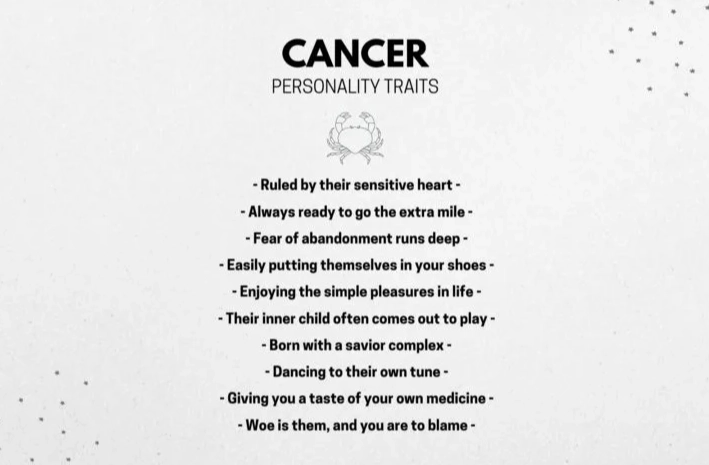
3. The Passive-Aggressive Masterclass
Confrontation? A direct "this hurt my feelings"? Too scary. The shell must be preserved. So, Cancers often become masters of indirect communication. The silent treatment. Sarcastic remarks disguised as jokes. "Fine, do whatever you want" when it's clearly not fine. They withdraw love and warmth as punishment, hoping you'll notice, feel guilty, and come crawling back to fix the unstated problem. It's a frustrating game where the rules are known only to them.
4. Holding Grudges Like Precious Heirlooms
Cancers have an elephant's memory for emotional slights. That thing you said in 2018 during an argument? It's archived, cross-referenced, and ready to be weaponized in a future dispute. Their sentimental nature works in reverse for negative experiences. They don't just remember the fact; they re-live the feeling. Forgiveness is a slow, arduous process because letting go of the hurt feels like letting go of a part of their history—even a painful one.
How These Traits Play Out in Real Life: Three Scenarios
Let's move from theory to practice. Here’s how these Cancer weaknesses manifest in everyday situations.
| Scenario | Typical Cancer Reaction (The Negative Trait) | The Underlying Fear/Need |
|---|---|---|
| At Work: A colleague criticizes their project idea in a meeting. | They shut down, contribute nothing for the rest of the meeting. Later, they might gossip about that colleague to a trusted desk-mate or "forget" to include them in an email chain. | Fear of public humiliation and rejection. Need for their creative "offspring" (ideas) to be protected and praised. |
| In Friendship: Their best friend has been busy with a new partner and cancelled plans twice. | They stop initiating contact. When the friend finally calls, they give short, cold answers ("I'm fine."). They post nostalgic photos of "when friends had time for each other" on social media. | Fear of being replaced and deemed unimportant. Need for consistent, demonstrable loyalty. |
| In Romantic Relationships: Their partner wants a weekend alone to recharge (introvert time). | They immediately become sulky and distant. "You just don't enjoy my company anymore." They might list all the things they've done for the partner recently, implying ingratitude. | Fear of abandonment and interpreting space as emotional rejection. Need for constant proximity as proof of love. |
See the pattern? The behavior is a symptom. The cause is almost always a threatened sense of security or emotional safety.
How to Manage Cancer Negative Traits (For Cancers & Those Who Love Them)
Knowing the problem is half the battle. The other half is strategy. Here are actionable steps, not just platitudes.
If You Are a Cancer:
- Name the Emotion, Don't Be the Emotion: When you feel a mood crashing down, practice saying (out loud or in a journal): "I am feeling overwhelmed with sadness right now," instead of just being a sad presence in the room. This creates a tiny gap between you and the feeling.
- Set a "Grudge Expiry Date": Consciously decide to shelf a grievance for 48 hours. After that, you must either address it directly with the person using "I feel" statements, or make a conscious choice to release it. Don't let it fossilize.
- Ask for What You Need, Directly: This is the hardest one. Instead of withdrawing when you need reassurance, try the script: "I'm feeling a bit insecure about [X]. I would really value some reassurance from you right now." It feels vulnerable, but it's a game-changer.
If You're Dealing with a Cancer:
- Validate Before You Solve: When they're emotional, your first job isn't to fix it. It's to validate. "That sounds really hurtful, I can see why you'd be upset." This disarms the defensiveness faster than logic.
- Be Proactively Reassuring: Don't wait for their insecurity to flare up. Offer unsolicited reassurance. "I'm really looking forward to our date Friday, it's the highlight of my week." This fills their security tank preemptively.
- Call Out Passive-Aggression Gently but Firmly: Don't play the game. Say, "I'm getting the sense you're upset with me from your tone. I care about you, but I can't fix what I don't understand. Can you tell me directly what's wrong?" This forces healthier communication.
When Negative Traits Cross the Line: Recognizing Toxic Patterns
Sometimes, negative traits escalate beyond typical zodiac flaws into emotionally draining or abusive territory. It's crucial to recognize the difference.
Emotional Blackmail: Using your love for them as a weapon ("If you really loved me, you would..."). Leveraging their vulnerability to control your actions.
Gaslighting About Feelings: Dismissing your valid concerns by blaming their "sensitivity" ("You know how emotional I get, why would you say that?"). Making you feel responsible for managing their moods to the point where you suppress your own needs.
Isolation: The clinginess morphs into actively discouraging or sabotaging your other relationships (with friends, family) under the guise of "needing you more" or "they don't understand our bond."
If you see these patterns, the issue is no longer astrological; it's about personal boundaries and, potentially, your well-being. Setting hard limits or seeking distance is not a failure to understand their sign—it's self-preservation.
Your Burning Questions Answered
 How can I, as a Cancer, stop being so clingy in my relationships without feeling abandoned?